
Flexible Network Cable for Live Sound: CAT5e vs CAT6a and Why It Matters
The right flexible network cable for live sound is one of the most consequential and least discussed decisions in a professional AV system build. Get it right and the network is invisible — it just works, show after show, deployment after deployment. Get it wrong and you are chasing intermittent dropouts, diagnosing phantom faults, and replacing cable that was never fit for purpose in the first place.
This article is written for AV integrators, systems contractors, and live sound engineers who are specifying or sourcing network cable for touring rigs, permanent venue installations, and AV-over-IP infrastructure. It covers what separates touring-grade network cable from standard install cable, how to approach Dante cable touring requirements specifically, and how the CAT5e vs CAT6a professional AV decision should actually be made — without the generic advice that fills most cable selection guides.
Why Standard CAT5e Install Cable Fails in Live Sound Environments
The default assumption when specifying network cable is that CAT5e or CAT6 from an IT supplier will do the job. In a fixed office installation where cable is pulled through conduit once and never touched again, that assumption is largely correct. In a live sound environment, it is wrong — and the failure mode is predictable.
Standard CAT5e and CAT6 install cable uses solid conductors. Each of the eight cores inside the cable is a single copper strand, chosen for its excellent electrical performance in static installations and its cost efficiency at scale. The problem is mechanical: solid copper work-hardens when it is flexed repeatedly. Coil a solid-conductor cable, uncoil it, route it across a stage, pack it into a touring case, and do that fifty times — and the conductors will begin to fatigue and eventually fracture.
When a conductor fractures inside an intact jacket, the cable presents no obvious physical fault. What you get instead is intermittent link drops, packet loss, and the kind of network instability that is extremely difficult to diagnose under show conditions.
This is why the first specification requirement for any flexible network cable for live sound is stranded conductors. Stranded construction distributes mechanical stress across multiple individual filaments rather than concentrating it in a single wire. The cable flexes without fatigue, survives repeated deployment, and maintains electrical integrity across its service life. It costs more than solid-conductor install cable. It is worth it.
What Makes a Network Cable Suitable for Touring Use
Beyond stranded conductors, a touring-grade network cable needs to satisfy several construction requirements that standard IT cable does not address.
- Screening is the first. Live sound environments are electrically hostile — stage lighting dimmers, motor controllers, power distribution running in close proximity to signal cable, and high-power RF from wireless systems all generate interference that unscreened cable will pick up. An unscreened UTP cable running alongside a dimmer rack is a noise source waiting to manifest. Screened cable — either F/UTP with a single foil screen or S/FTP with individual pair screens and an overall braid — provides the noise rejection that professional AV infrastructure demands.
- Jacket toughness is the second. Standard PVC jackets handle indoor static installation adequately. Cable that gets dragged across concrete stages, packed into flight cases, and deployed outdoors needs a jacket that resists abrasion, mechanical wear, and in some cases oils and outdoor exposure. Polyurethane jackets offer materially better toughness than standard PVC in these conditions.
- Connector compatibility is the third, and often overlooked. Professional touring network cable needs to terminate reliably with Neutrik EtherCon connectors — the locking RJ45 format that has become standard across professional AV touring because it resists accidental disconnection and survives the physical abuse of stage use. Not all cable diameters and conductor configurations are compatible with EtherCon tooling, so connector fit needs to be part of the cable specification decision, not an afterthought.
Dante Cable Touring: What the Protocol Actually Requires
Dante is the dominant audio-over-IP protocol in professional live sound, and Dante cable touring requirements are specific enough to be worth addressing directly. Dante runs over standard Ethernet infrastructure, which means the cable requirements are driven by Gigabit Ethernet performance rather than any Dante-specific standard — but the environment in which that cable operates introduces demands that generic Gigabit cable cannot always meet.
Audinate, the developer of Dante, recommends stranded conductors for touring and patch applications precisely because of the mechanical stress issue described above. Solid-core cable is explicitly noted as suited for fixed installation rather than dynamic use. For Dante networks on tour — where the cable between the console, stage box, and network switch is coiled, deployed, and packed repeatedly — stranded screened cable is the correct specification.
The network performance requirement for Dante is Gigabit Ethernet on all links. CAT5e handles this comfortably within its rated channel length. The screening requirement is driven by the environment: in venues with high dimmer loads, large motor rigs, or dense wireless infrastructure, screened cable protects Dante’s latency-sensitive audio packets from the interference that would cause packet errors and audible artefacts in the audio output.
For Dante cable touring specifically, the practical specification is a flexible stranded screened CAT5e or CAT6a cable terminated with Neutrik EtherCon connectors, with run lengths kept within the cable’s verified Gigabit channel performance. The Van Damme TourCat range addresses this requirement directly — the CAT5e 268450000 for standard Gigabit Dante networks, and the CAT6a 268466000 where 10G headroom or higher-density systems demand the additional bandwidth.
CAT5e vs CAT6a Professional AV: How to Make the Decision
The CAT5e vs CAT6a professional AV debate comes up on almost every networked AV project, and the answer is less complicated than it is sometimes made to appear. Here is a practical framework.
Choose CAT5e when:
The system runs Dante, AES67, or standard Gigabit AV-over-IP protocols. CAT5e is rated for Gigabit Ethernet to 100 metres under ideal conditions, and independently verified to 53 metres at Gigabit in the Van Damme TourCat specification. For the vast majority of stage patch and link cable applications, 53 metres is well within operational distances. CAT5e delivers everything a Gigabit Dante network needs, at a lower cost per metre than CAT6a. It is the correct choice for most live sound touring applications where 10G is not a current requirement.
Choose CAT6a when:
The system carries video-over-IP — NDI, SDVoE, or other high-bandwidth protocols that push toward or beyond Gigabit. These protocols benefit directly from the additional bandwidth headroom CAT6a provides, and some will require 10G infrastructure as resolution and channel counts scale. CAT6a is also the correct choice when future-proofing is a genuine project requirement: installing CAT6a from the outset removes the need to re-cable when the system’s network demands increase.
The Van Damme TourCat CAT6a 268466000 is rated for 10G transmission to 60 metres and Gigabit to 75 metres, independently verified by Fluke DTX1800 testing. Its S/FTP dual-screening construction — individual foil screens on each pair plus an overall tinned copper braid — provides substantially better noise rejection than a single-screened F/UTP CAT5e, making it the right specification for installations in the most electrically demanding environments.
The honest answer on most live sound projects:
For a touring Dante rig running audio only, well-specified CAT5e is sufficient. For a hybrid audio and video-over-IP system, or any project where the network will need to scale, CAT6a is the better long-term investment. The price difference between well-made CAT5e and CAT6a is not large enough to be the deciding factor — the application and future requirements should drive the decision.
The Van Damme TourCat Range: Built for This
Van Damme’s TourCat cables address both tiers of this decision with products built specifically for professional AV and touring use rather than adapted from IT infrastructure cable.

- The TourCat CAT5e 268450000 is a flexible stranded F/UTP cable with 7 × 0.16 mm bare oxygen-free copper conductors, an aluminium/polyester foil screen with greater than 100% coverage, and a flexible PVC composite jacket at 6.00 mm overall diameter. It meets TIA/EIA-568-C-2 and has been Fluke DTX verified for Gigabit channel link performance to 53 metres. It is the correct touring Dante cable for live sound applications where Gigabit performance is the requirement.
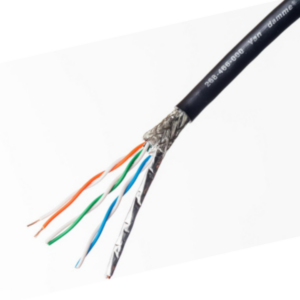
- The TourCat CAT6a 268466000 is the MKII redesign — a flexible stranded S/FTP cable with a polyurethane outer jacket, individual pair foil screens at greater than 125% coverage, and an overall tinned copper braid. It is rated for 10G to 60 metres and Gigabit to 75 metres, verified by Fluke DTX1800 testing. The dual-screening architecture and polyurethane jacket make it the specification-grade choice for video-over-IP infrastructure, high-density Dante networks, and projects where the cable needs to perform in the most demanding physical and electrical environments.
Both cables are compatible with Neutrik EtherCon connectors and are available per metre or on 100 m reels up to a maximum reel length of 500 m.
Sourcing Van Damme TourCat Cable Through Surgesound
Surgesound is an authorised Van Damme distributor supplying AV integrators, systems contractors, and project managers across Southern Africa. Both TourCat cables are available for direct supply to trade accounts — per metre for custom assembly lengths, or on reel for bulk project requirements.
To discuss pricing, stock availability, or project quantities for the Van Damme TourCat range, contact the Surgesound team directly.
View more Van Damme Cable HERE.

Precision Engineering since 1987
The Van Damme range has been designed, engineered and refined for over three decades as a result of technological advances and customer driven requirements.
This comprehensive and intelligent yet practical range of specialist audio and video cables has achieved premier status simply by being the finest cable range of its type on the open market.
Listening closely to customers and keeping our finger ‘on the pulse’ has afforded us the enviable position of offering our clients what they truly need without compromise.
The highly evolved products in this site are a result of years of keeping ‘in tune’ with our customers coupled with our own refinements and exhaustive research and development into cabling technology.
We have incorporated into the Van Damme range many new and innovative ideas never seen before. These are designed to cater for anything from eco-friendly to user friendly, this largely depending on whether it is an architectural specification or the rigours of touring.
What we believe we have created are truly elegant cabling solutions for a vast array of applications.
This is why Van Damme is employed so confidently on the stages, studios and screens across the world.
We feel our client list says it all.