
When specifying the speaker output stage of any commercial audio installation, the choice between High Impedance vs Low Impedance Systems is one of the most fundamental decisions you will make. It determines how many speakers you can drive, how far the cable can run, what audio quality the system can deliver, and how the installation is wired. Get it right and the system performs exactly as designed. Get it wrong and you face power loss, overloaded amplifiers, and a client unhappy with the result.
This guide covers the 7 essential facts about high impedance vs low impedance systems that every AV integrator and project manager needs to understand before specifying a commercial audio installation.
Fact 1: High impedance vs low impedance systems operate at the same stage of the signal chain
Both high impedance and low impedance systems are speaker distribution methods — they operate at the amplifier output stage, after the audio signal has been processed and amplified. This is an important distinction. High impedance vs low impedance is not a question about how signal travels between devices in your rack or across a building at line level. It is specifically about how the amplifier connects to and drives the speakers.
Understanding this keeps the comparison clean. When AV integrators ask about high impedance vs low impedance systems, they are asking about speaker wiring architecture — not signal distribution between equipment, which is a separate design decision.
Fact 2: High impedance systems step voltage up to drive many speakers over long distances
A high impedance system — most commonly implemented as 100V line — works by stepping the amplifier output voltage up to a fixed 100 volt rail using a built-in output transformer. Each speaker on the system has its own step-down transformer that converts the 100V back down to the low voltage the speaker driver needs, tapping only the wattage it requires and leaving the rest available for other speakers on the same line.
The physics behind high impedance systems is the same principle as the electricity grid — transmitting power at high voltage keeps the current low, which minimises resistive losses in the cable. The practical result is that a high impedance system can drive a large number of speakers over very long cable runs using relatively thin two-core cable, all from a single amplifier channel. This is why high impedance systems are the default choice for distributed commercial audio across large buildings, campuses, and outdoor environments.
Per-speaker volume is set by selecting a wattage tap on the step-down transformer — typically offering options of 1W, 2W, 5W, 10W, and 20W. The total of all speaker tap settings across the line must not exceed the amplifier’s rated output. Load calculation is straightforward: sum all the tap wattages, stay within 80% of the amplifier rating, and the system is correctly loaded.
100V line is the standard term across Southern Africa, the UK, and most international markets. The same system is referred to as 70V line in North America — the operating principle is identical, only the line voltage differs.
Fact 3: Low impedance systems drive speakers directly for full audio fidelity
In a low impedance system, the amplifier drives the speakers directly at low impedance — typically 4Ω or 8Ω per speaker — with no transformer in the signal path. This direct coupling is what gives low impedance systems their core advantage: the full frequency range of the audio signal is reproduced faithfully, from deep bass through to the highest frequencies, with nothing in the signal path to colour or limit the response.
Low impedance systems are the standard for any application where audio quality is a primary requirement — live sound, recording and broadcast facilities, houses of worship with premium audio expectations, and any commercial installation where foreground music or high-fidelity reproduction is part of the brief. When a client can clearly hear the audio and judges it critically, a low impedance system is the right choice.
The trade-off is that low impedance systems require careful impedance management. A Lo-Z amplifier can only drive a limited number of speakers before the combined impedance drops below what it can safely handle. Two 8Ω speakers in parallel present a 4Ω load. Four present a 2Ω load — potentially too low for the amplifier. This means low impedance installations typically require one amplifier channel per speaker or per zone, which increases amplifier count and system cost.
Fact 4: Cable distance is where high impedance systems win decisively
Cable resistance is the critical factor that separates the two systems on large installations. In a low impedance system, the current flowing through the cable is relatively high. As cable runs get longer, the resistance of the cable becomes a significant fraction of the total circuit impedance — absorbing power that should be driving the speaker. On a long run, this results in noticeably reduced output at the speaker and degraded frequency response. Compensating requires heavier cable gauge, higher amplifier power, or both.
In a high impedance system, the 100V line presents a very high impedance at the speaker transformer primary — typically around 1,000Ω or more. Even if the cable resistance reaches 8Ω over a long run, that is less than 1% of the load impedance. The effect on output level is negligible. This is why high impedance vs low impedance systems is not a close call when the installation involves long cable runs — the high impedance system wins on this factor without question.
Fact 5: High impedance systems have a frequency response limitation
The transformer in a high impedance system — both the amplifier output transformer and the step-down transformer in each speaker — introduces a degree of high-frequency roll-off. The extent depends on transformer quality, but even good-quality 100V line transformers limit the upper frequency extension compared to a direct-drive low impedance connection.
For background music and PA voice applications, this is completely irrelevant. The human voice and background music at moderate levels do not require the full frequency bandwidth that a high-end low impedance system can deliver, and the difference is not perceptible in a typical commercial background music environment. However, for foreground music zones, live sound applications, or any installation where the client expects studio-quality audio reproduction, the transformer limitation in a high impedance system is a meaningful constraint. Low impedance direct drive is the correct choice in those contexts.
Fact 6: Many commercial installations correctly use both systems
The comparison of high impedance vs low impedance systems is not always an either/or decision. On larger commercial projects, the most practical and cost-effective design frequently uses both in the same installation — each system applied to the zones where it is the right fit.
A hotel is a clear example. The lobby feature area, the main restaurant, and the bar are specified as low impedance direct-drive systems using quality architectural speakers — because guests in those zones have a direct and conscious listening experience and audio quality is part of the brand expectation. The corridors, service areas, poolside, and pathway speakers are specified as a high impedance 100V line system — because those are distributed background music applications where coverage, long cable runs, and simplicity matter more than audiophile performance.
The same DSP and amplifier rack serves both systems. The DSP routes processed outputs to a low impedance power amplifier for the premium zones and to a 100V line amplifier for the distributed zones. Both systems are designed, wired, and commissioned independently within the same project. This is standard practice on well-designed commercial installations.
Fact 7: Choosing the wrong system creates problems that are expensive to fix
Specifying a low impedance system for a distributed installation with long cable runs results in power loss, uneven speaker output across the system, and potentially damaged amplifiers if impedance loads are not carefully managed. Specifying a high impedance system for a premium foreground music zone results in a client who can hear the frequency limitations and is dissatisfied with the result. Both mistakes are avoidable at the design stage and expensive to correct after installation. Using guides like this can aid in choosing High Impedance vs Low Impedance Systems.
The five most common specification errors on high impedance vs low impedance systems are:
- Using low impedance for long distributed runs: Cable resistance absorbs power — speakers at the end of long runs will be noticeably quieter and the frequency response will suffer
- Using high impedance for premium foreground zones: The transformer limits frequency response — not appropriate where critical listening is expected
- Exceeding the amplifier wattage on a 100V line system: Always sum all speaker tap wattages before expanding an existing high impedance system — adding speakers without recalculating is a common mistake
- Using poor-quality transformers on high impedance systems: Cheap line transformers introduce audible colouration and fail prematurely under continuous use
- Mixing high and low impedance speakers on the same amplifier output: These are incompatible at the speaker output stage — a 100V line output will damage a speaker not equipped with a matching transformer
High impedance vs low impedance systems: choosing the right one for your project
The table below maps common project types to the correct system choice — use it as a quick reference when specifying:
| Application | Recommended system | Reason |
| Office building — PA and BGM across multiple floors | High impedance system | Long cable runs, many speakers, BGM and voice paging only |
| Retail and shopping centres | High impedance system | Wide coverage, simple zoning, background music application |
| Schools, universities, hospitals | High impedance system | PA voice clarity, large number of speakers, ease of expansion |
| Warehouse and factory PA | High impedance system | Long distances, horn speakers, voice intelligibility priority |
| Restaurant or bar — background music zones | High impedance system | Multiple ceiling speakers, long runs, BGM application |
| Premium restaurant or bar — foreground music zone | Low impedance system | High-fidelity reproduction required, short runs to quality speakers |
| Recording studio or broadcast facility | Low impedance system | Full frequency response essential — transformers not acceptable |
| Live sound — FOH system | Low impedance system | High SPL, full bandwidth, professional loudspeaker systems |
| House of worship — main PA system | Low impedance system | High-fidelity speech and music with line array or point source |
| House of worship — overflow and lobby fill | High impedance system | Distributed secondary coverage — speech relay and BGM |
| Hotel lobby or premium feature zone | Low impedance system | Premium audio quality expected — direct-drive architectural speakers |
| Hotel corridors, poolside, pathways | High impedance system | Distributed background music, long runs, coverage priority |
Full comparison: high impedance vs low impedance systems
For a complete side-by-side breakdown across all the technical and practical factors that affect your specification decision:
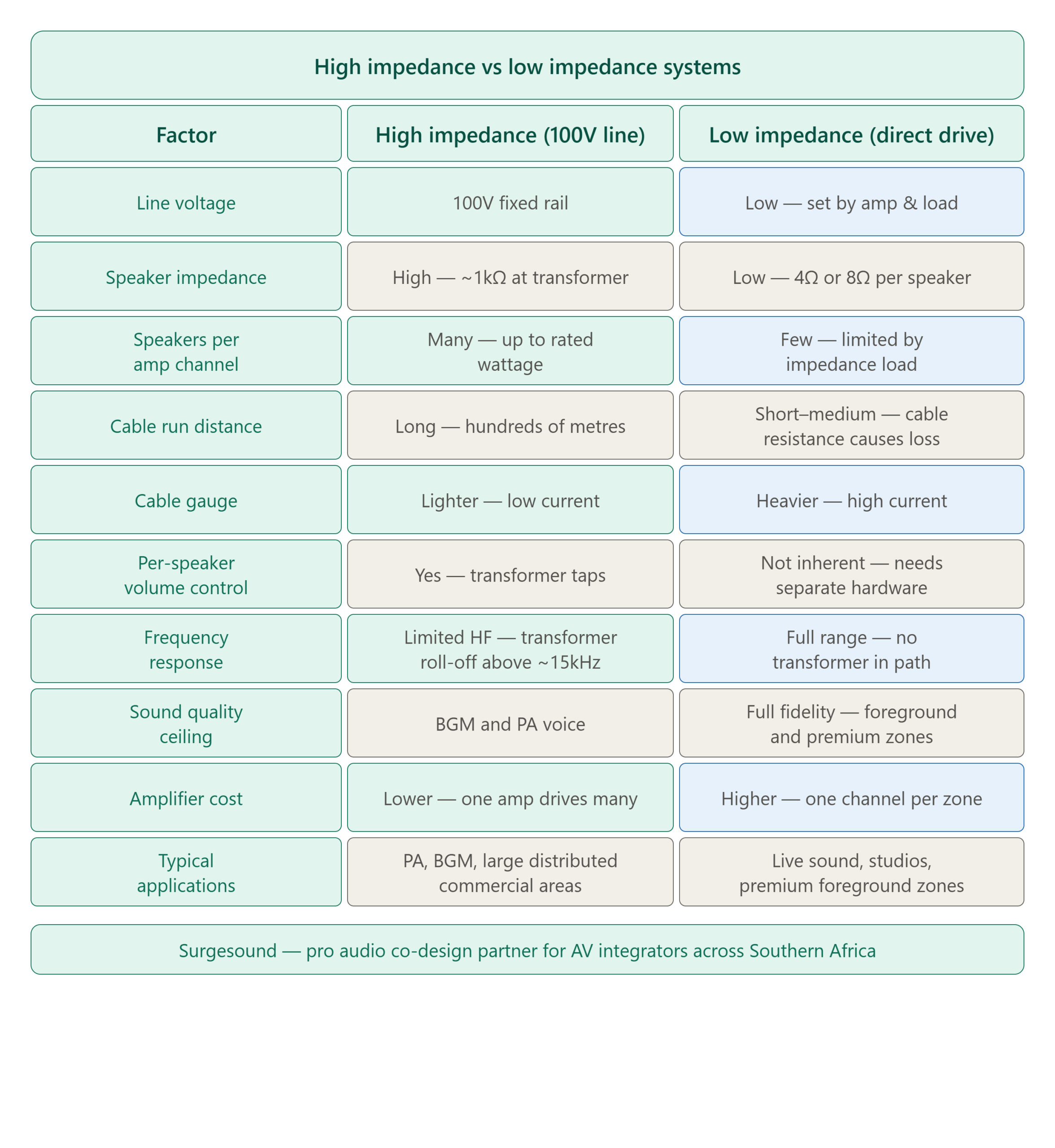
How Surgesound supports your High Impedance vs Low Impedance Systems design across Southern Africa
Surgesound is a B2B co-design partner and professional pro audio hardware supplier for AV integrators, project managers, and consultants across Southern Africa. Whether your project calls for a high impedance system, a low impedance system, or a combination of both, we provide:
- System design support — determining the correct architecture for each zone based on cable distances, speaker count, and audio quality requirements
- Load calculations and amplifier sizing — verifying 100V line loads and low impedance configurations are within specification before procurement
- Hardware supply — professional 100V line amplifiers, direct-drive power amplifiers, commercial ceiling speakers, architectural low impedance speakers, and line transformers
- On-site commissioning support — transformer tap setting, gain staging, and system verification at project handover
Not sure whether your next project calls for a high impedance system, a low impedance system, or both? Bring Surgesound in at the design stage — we will review your floor plan, cable routes, and zone requirements and give you a clear recommendation at no co-design cost.
Contact Surgesound to discuss the right High Impedance vs Low Impedance Systems speaker system architecture for your next commercial audio installation.
Industry standards and bodies for AV integrators
Commercial audio installations — including the specification of high impedance vs low impedance systems — are guided by internationally recognised standards developed by AVIXA (the Audiovisual and Integrated Experience Association). Formerly known as InfoComm International, AVIXA establishes internationally accepted standards to guarantee uniformity, interoperability, and peak performance in audiovisual projects.
The most relevant standard for AV integrators specifying speaker systems is ANSI/AVIXA D401.01:2023, which establishes best practice for documentation and provides a framework for coordinating complex AV system designs and installations, outlining standardised processes from programming to closeout.
AVIXA standards are balanced and open, so everyone in the AV industry can benefit from incorporating them into their projects — supporting technology design and procedures that focus on reliability, competency, and success.
For AV integrators and project managers in Southern Africa, aligning your system designs and documentation with AVIXA standards strengthens your tender submissions and demonstrates professional credibility to clients and consultants.
Relevant links: