18 Sound XG14 – 1.4-Inch Transmission Line Array Waveguide with 10° Vertical Coverage
The 18 Sound XG14 is a purpose-built 1.4-inch throat entry line array waveguide designed for professional line array loudspeaker systems. Unlike conventional horns that function as standalone directivity devices, the 18 Sound XG14 is an integrated waveguide that forms part of the line array element — its 10° vertical coverage defines the inter-element splay angle, its transmission line acoustical design minimises internal reflections and acoustic losses, and its horizontal coverage is partially determined by the cabinet walls that complete the waveguide’s mouth.
The transmission line design is the fundamental engineering distinction. Where conventional horns use exponential, conical, or constant-directivity flare profiles, the 18 Sound XG14 uses a transmission line geometry that guides the sound wave from the compression driver’s throat to the waveguide mouth through a controlled acoustic path. This path is engineered to minimise the internal reflections that cause comb-filtering and frequency response irregularities in conventional horn designs — producing cleaner, more phase-coherent output at the waveguide mouth.
The throat shape has been specifically optimised for reducing air distortion. At the high sound pressure levels that line array compression drivers produce, the air itself becomes a source of nonlinear distortion — the wavefront compresses and rarefies the air molecules asymmetrically, generating harmonic products. The 18 Sound XG14’s throat geometry manages this air distortion by controlling the pressure gradient from the compression driver exit to the waveguide’s expanding section.
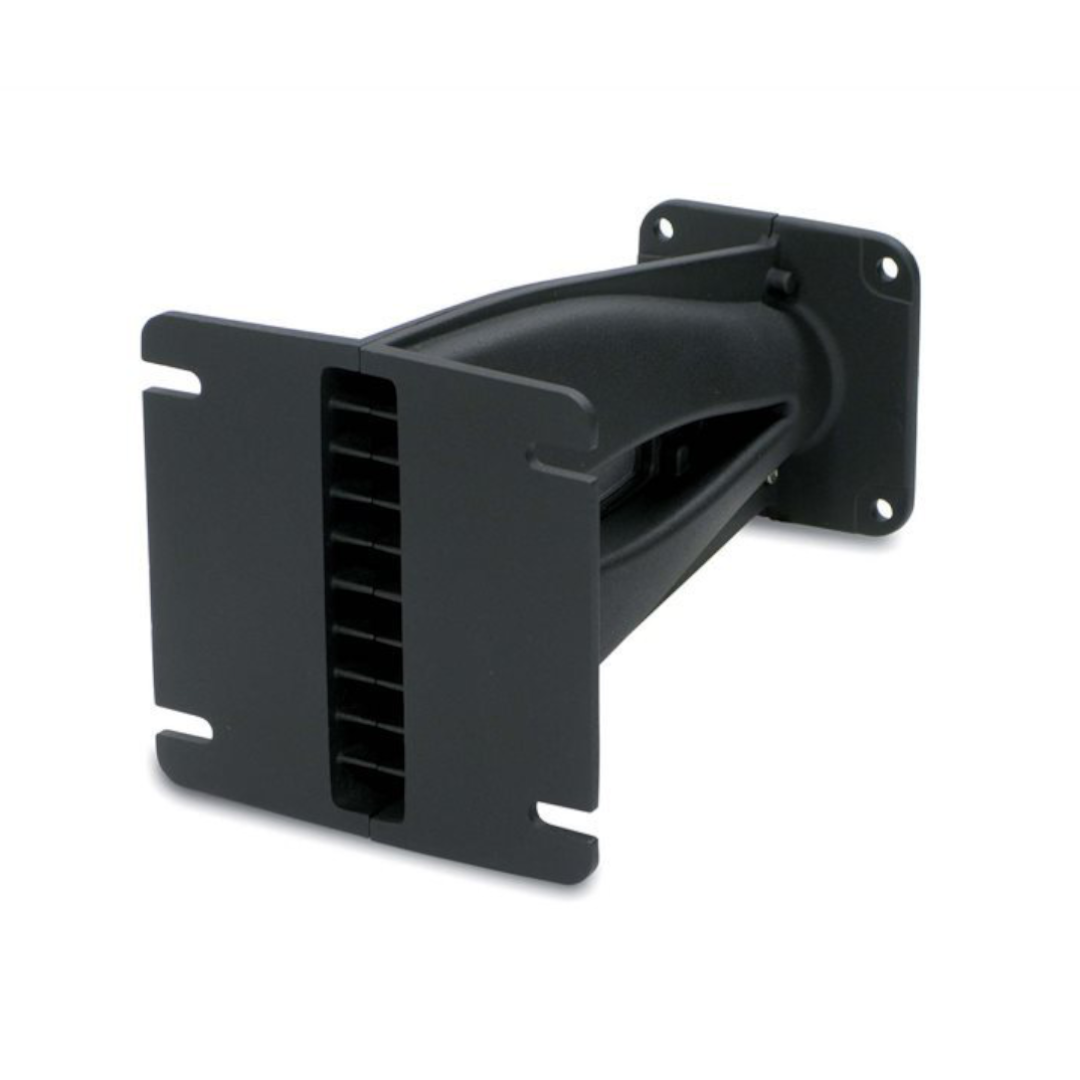
At 1.0 kg in diecast aluminium construction with a compact form factor designed for maximum array ability, the 18 Sound XG14 is engineered for line array elements where multiple waveguides stack vertically to form a coherent line source. 18Sound specifically optimised the waveguide for use with their ND1480A and NSD1424BTN 1.4-inch exit compression drivers.
Design and Construction of the 18 Sound XG14
The 18 Sound XG14 uses a transmission line acoustical design with a 35 mm (1.4-inch) throat entry. The transmission line approach is architecturally different from the exponential and constant-directivity flare profiles used in conventional horns like 18Sound’s own XR1496C and XR1464C.
In a transmission line waveguide, the internal geometry creates a series of progressive expansions that guide the sound wave from throat to mouth with minimal reflections at each transition. The goal is to deliver the compression driver’s output to the waveguide mouth with maximum phase coherence — meaning every frequency arrives at the mouth at the same time, producing a clean, well-defined wavefront that stacks coherently with adjacent elements in the line array.
Internal reflections are the enemy of line array coherence. When a sound wave reflects off an internal surface inside a conventional horn, the reflected energy travels back toward the throat, bounces again, and eventually exits the horn delayed relative to the direct sound. These delayed reflections cause comb-filtering — a series of peaks and cancellations in the frequency response that degrades the output quality. The 18 Sound XG14’s transmission line geometry minimises these reflections through smooth, progressive transitions that keep the energy moving forward toward the mouth.
The throat shape optimisation addresses a different distortion mechanism — air distortion at high SPL. When a compression driver produces high sound pressure at the throat, the air in the throat section is compressed and rarefied asymmetrically. This nonlinear compression generates harmonic distortion products that weren’t in the original signal. The 18 Sound XG14’s throat geometry manages the pressure distribution to reduce this effect, keeping the output clean at the sustained high-power levels that professional line array systems operate at.
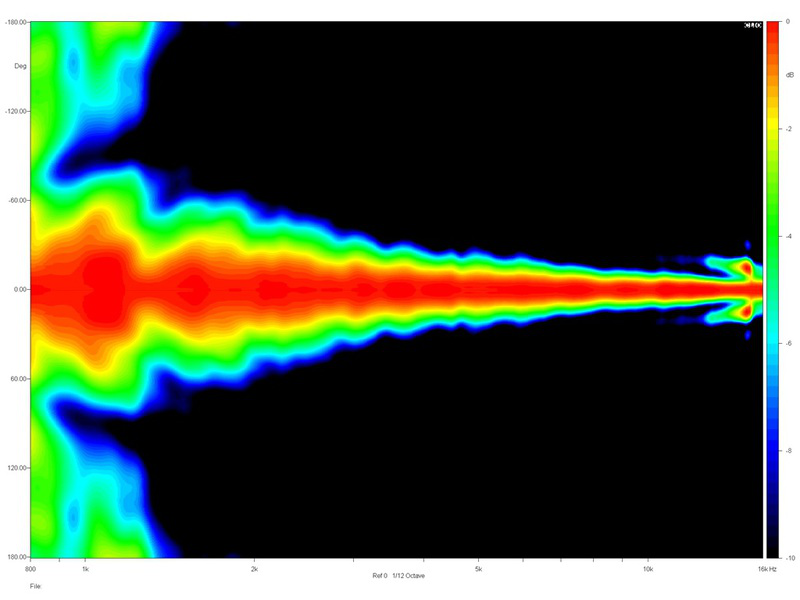
The 10° vertical coverage angle defines the 18 Sound XG14’s role in a line array. Each element covers a narrow vertical slice of the audience area. When multiple elements are stacked and angled, their combined coverage tiles together to create a tall, continuous vertical coverage pattern. The 10° figure means each element contributes a 10-degree vertical window — wide enough to cover a meaningful section of the audience, narrow enough to stack with adjacent elements without excessive overlap that would cause interference.
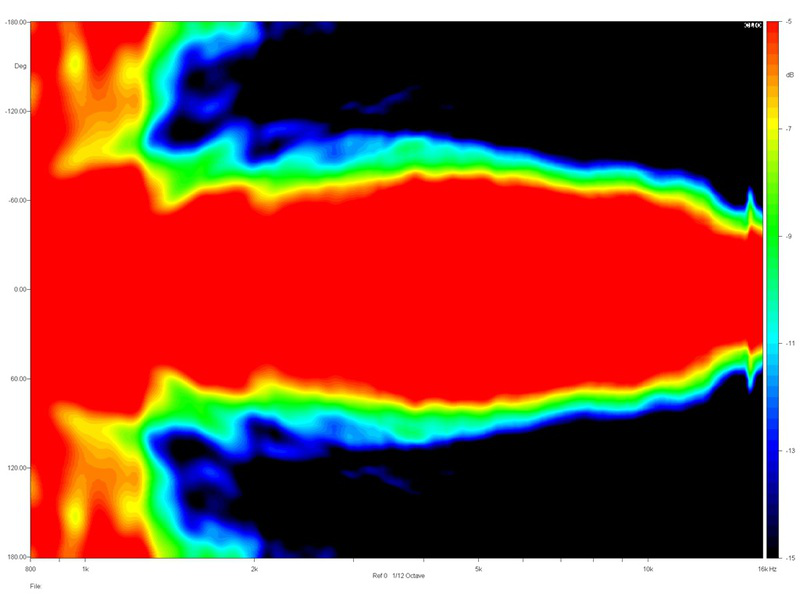
The horizontal coverage varies from 80° to 120° depending on the specific cabinet design. The 18 Sound XG14’s waveguide defines the vertical coverage through its internal geometry, but the horizontal coverage is partially formed by the cabinet walls that extend from the waveguide mouth to the baffle edges. Different cabinet widths produce different horizontal coverage angles. The nominal 100° horizontal figure represents the typical coverage in a standard line array element width. This cabinet-dependent horizontal coverage gives manufacturers the flexibility to tune coverage by adjusting element width without needing a different waveguide for each angle.
The diecast aluminium construction provides several advantages over the composite and ABS materials used in conventional horns. Aluminium is stiffer and more dimensionally stable — it won’t flex or deform under the acoustic pressures that sustained high-power line array operation generates. Aluminium is also an excellent thermal conductor, drawing heat away from the compression driver’s throat and dissipating it through the waveguide body. And diecast aluminium can be produced with the precise, repeatable tolerances that transmission line geometry requires — any dimensional variation between waveguides would produce inconsistent coverage between array elements.
The compact form factor is designed for high arrayability. Every millimetre of waveguide height contributes to the total array height, so compact dimensions mean shorter elements, more elements per metre of array, and finer resolution in the array’s vertical coverage pattern.
At 1.0 kg, the 18 Sound XG14 adds minimal weight to each line array element. In a 16-element array, the waveguides contribute 16 kg of total array weight — a modest contribution relative to the compression drivers, woofers, cabinet structure, and rigging hardware.
Performance and Applications for the 18 Sound XG14
The 18 Sound XG14 provides 100° horizontal × 10° vertical coverage when loaded with a compatible 18Sound 1.4-inch exit compression driver. Sensitivity is measured at 1 W input on the ND1480A’s rated impedance at 1 m on-axis, averaged between 1 kHz and 4 kHz — the standard measurement method for line array waveguides.
The recommended crossover frequency of 1.0 kHz defines the lowest frequency at which the 18 Sound XG14 provides useful waveguide loading and pattern control. Above 1 kHz, the transmission line geometry shapes the compression driver’s output into the controlled 10° vertical window. Below 1 kHz, the waveguide’s dimensions are too small relative to the wavelength to maintain effective pattern control, and the output transitions to a more omnidirectional pattern.
The 1.0 kHz crossover capability means the 18 Sound XG14 pairs with 18Sound’s most capable 1.4-inch compression drivers. The ND1480A and NSD1424BTN are specifically called out as optimised partners — both are 1.4-inch exit drivers with the sensitivity, power handling, and bandwidth to exploit the 18 Sound XG14’s transmission line performance.
The transmission line’s phase coherence advantage is most audible in the mid-range — the 1–4 kHz band where vocal intelligibility and musical presence are defined. In this range, the 18 Sound XG14 delivers cleaner output with fewer comb-filtering artefacts than conventional horn designs, which translates to better vocal clarity, smoother frequency response, and more consistent tonal balance across the array’s coverage area.
The air distortion reduction at the throat is a high-SPL advantage. At moderate power levels, air distortion is negligible. At the sustained high power levels that touring line arrays operate at — where each element’s compression driver is running at or near full rated power for hours — the throat geometry’s distortion reduction produces measurably cleaner output. The difference compounds across a full array.
The diecast aluminium construction provides the dimensional consistency that line array coherence demands. Every 18 Sound XG14 waveguide is dimensionally identical — the diecasting process produces tolerances tight enough that coverage angles and phase behaviour are consistent from waveguide to waveguide. When 16 waveguides stack in an array, they behave as one coherent source because their individual outputs are phase-matched by manufacturing precision.
Conclusion – 18 Sound XG14 Line Array Waveguide
The 18 Sound XG14 is a transmission line waveguide engineered specifically for professional line array applications. The transmission line design minimises internal reflections for cleaner phase coherence. The optimised throat geometry reduces air distortion at high SPL. The 10° vertical coverage provides the narrow element dispersion that line arrays require for coherent vertical stacking. And the diecast aluminium construction delivers the dimensional precision and thermal management that sustained professional operation demands.
The 18 Sound XG14 is not a conventional horn repurposed for line array use. It’s a ground-up line array waveguide designed around the specific acoustic requirements of multi-element vertical arrays — phase coherence between elements, minimal internal reflections, controlled vertical dispersion, and cabinet-integrated horizontal coverage. The transmission line approach addresses these requirements more directly than conventional horn geometries.
For professional line array systems, touring rigs, festival PA, and any multi-element array design where the HF waveguide needs to deliver maximum phase coherence with minimum internal artefacts from a compact, lightweight, dimensionally precise diecast aluminium package, the 18 Sound XG14 is the 1.4-inch line array waveguide that 18Sound engineered from scratch for the format. Transmission line design, 10° vertical, 1.0 kg, diecast aluminium — purpose-built for the array.

VIEW MORE 18 Sound PRODUCTS HERE.
About 18 Sound

18 Sound products are proudly made in Reggio Emilia, Italy, combining advanced technology with Italian craftsmanship. Known for their high-performance professional audio components, 18 Sound is a trusted name in the global audio industry. Their state-of-the-art manufacturing and strict quality control ensure exceptional reliability and sound clarity. 18 Sound products are designed to meet the demands of speaker builders and audio professionals; 18 Sound offers premium products with outstanding value and performance worldwide.