
B&C ME7 – Compact Exponential Horn Flare with 60° × 40° Coverage for Small-Format Two-Way Systems
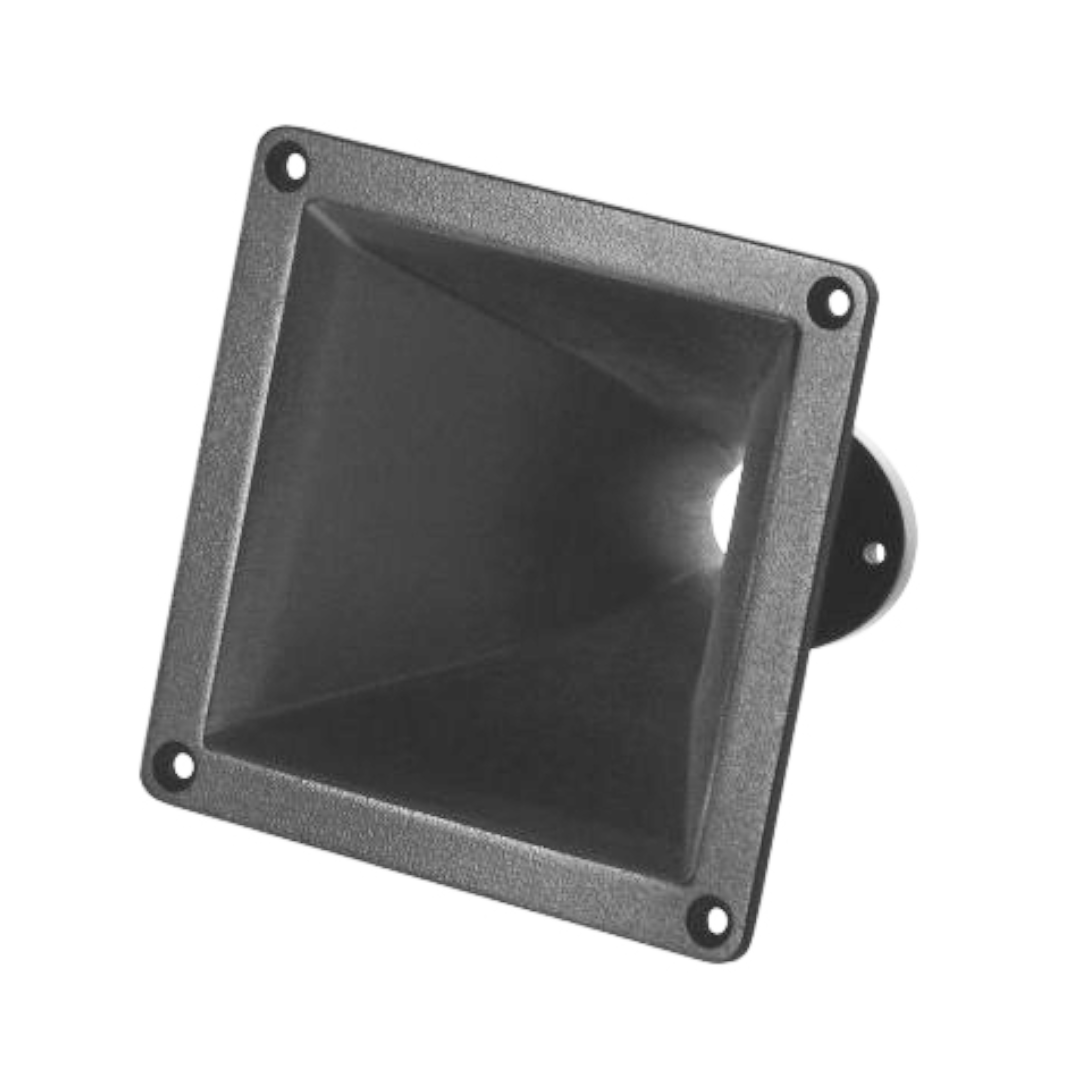
The B&C ME7 is a compact exponential horn flare designed for small-format two-way speaker systems where controlled directivity, efficient loading, and minimal cabinet footprint are the design priorities. With a 0.75-inch (19 mm) throat entry, 60° × 40° nominal coverage, a 2 kHz cutoff frequency, and a 122 × 122 mm face that weighs just 0.11 kg, the B&C ME7 delivers professional pattern control from a horn small enough to fit into the tightest portable PA cabinets, compact stage monitors, and lightweight two-way tops.
The exponential flare profile is the most established horn geometry in professional audio. It provides smooth, progressive acoustic impedance transformation from the throat to the mouth, loading the compression driver efficiently from the 2 kHz cutoff frequency upward. The B&C ME7’s exponential expansion rate is engineered to produce consistent loading behaviour across the operating bandwidth — the kind of predictable, well-behaved acoustic performance that system designers rely on when specifying a horn for professional use.
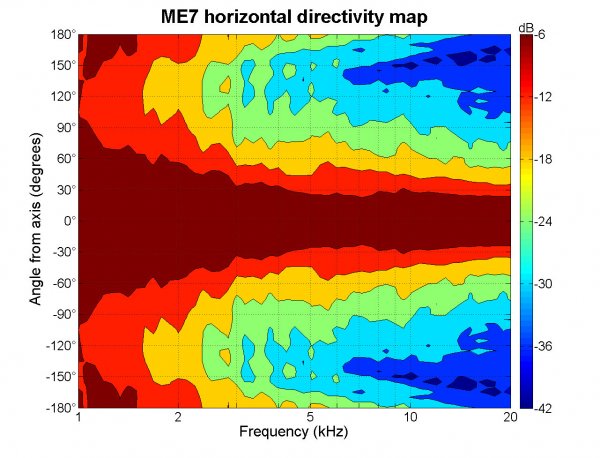
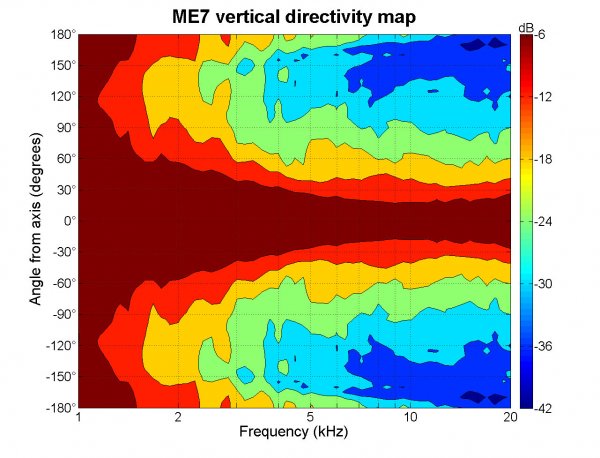
The 60° × 40° coverage pattern provides asymmetric dispersion — wider horizontal coverage for audience spread, narrower vertical coverage to reduce floor and ceiling reflections. This is the standard geometry for compact PA applications where the horn needs to cover a wide listening area horizontally while keeping vertical energy focused to maximise throw and minimise room interaction. The asymmetric pattern ensures more of the compression driver’s output reaches the audience and less of it is wasted on room surfaces.
At 0.11 kg, the B&C ME7 adds virtually zero weight to a speaker cabinet. The ABS construction is lightweight, impact-resistant, and acoustically inert — it doesn’t resonate or colour the sound the way thin metal horns can. For portable PA systems and lightweight speaker builds where every gram of cabinet weight matters, the B&C ME7 is a horn that disappears into the design without affecting the weight equation.
The 0.75-inch throat entry is the smallest in B&C’s horn range, making the B&C ME7 the entry point for builders seeking controlled directivity from the most compact horn format B&C offers.
Design and Construction of the B&C ME7
The B&C ME7 uses an exponential flare profile with a 19 mm (0.75-inch) throat entry expanding to the 122 × 122 mm mouth. The exponential expansion rate is calculated to provide smooth acoustic loading from 2 kHz upward — the horn’s cross-sectional area increases progressively from throat to mouth following an exponential curve that maintains consistent impedance transformation across the operating bandwidth.
The physics behind the exponential flare are straightforward. A compression driver generates high acoustic pressure at its throat — significantly higher than the ambient air pressure at the horn mouth. The flare acts as an acoustic transformer, gradually reducing this pressure while increasing the velocity of the air particles, matching the high-impedance throat to the low-impedance open air. The exponential curve does this more smoothly than conical or hyperbolic profiles, producing fewer reflections inside the horn and less distortion at the output.
The 0.75-inch throat entry is the smallest in B&C’s horn range. This throat size is designed for compact compression drivers with matching exit diameters. The small throat provides efficient coupling with small-format HF transducers while keeping the overall horn dimensions compact enough for cabinets where a larger horn would consume too much baffle area or internal volume.
The throat-to-mouth expansion ratio determines the horn’s cutoff frequency — the lowest frequency at which the horn provides useful acoustic loading. The B&C ME7’s geometry produces a 2 kHz cutoff, which means the horn loads the compression driver effectively from 2 kHz upward. Below 2 kHz, the horn’s mouth becomes too small relative to the wavelength to maintain efficient coupling with the air, and the output rolls off progressively.
The 60° × 40° nominal coverage angles define the horn’s dispersion behaviour above the cutoff frequency. At frequencies well above 2 kHz, the B&C ME7 maintains controlled 60° horizontal and 40° vertical dispersion, directing the compression driver’s output into a defined coverage window rather than allowing it to radiate in an uncontrolled pattern.
As frequency increases toward the upper treble, the coverage pattern naturally narrows — a characteristic of all finite-sized horns governed by the relationship between wavelength and mouth dimensions. The B&C ME7’s exponential flare maintains more consistent pattern control across frequency than simpler conical designs, which tend to narrow more dramatically as frequency rises.
The ABS (Acrylonitrile Butadiene Styrene) construction provides an excellent balance of weight, strength, and acoustic properties for a horn at this scale. ABS is rigid enough to resist flexing under the acoustic pressures generated by the compression driver. It’s impact-resistant enough to survive the handling that portable PA gear endures on a daily basis. And it’s acoustically dead enough to avoid adding resonant coloration to the output.
The smooth interior surface of the B&C ME7 minimises turbulence and boundary layer effects as sound waves travel from the throat to the mouth. Surface irregularities inside a horn create micro-reflections and turbulence that add distortion — the B&C ME7’s moulded ABS interior maintains the smooth, continuous surface that clean acoustic propagation requires.
The 122 × 122 mm square face fits into compact cabinet designs where round or oversized horn mouths would consume too much baffle area. The square format tiles efficiently alongside woofers on a baffle, and the straight edges align cleanly with cabinet geometry. The 102 mm depth keeps the horn shallow — critical for portable cabinets where internal volume is limited and every millimetre of depth trades off against enclosure volume available for the woofer section.
Performance and Applications for the B&C ME7
The B&C ME7 provides 60° × 40° controlled coverage from its 2 kHz cutoff frequency through the upper treble of the paired compression driver. The horn’s primary job is directivity control — it shapes the compression driver’s output into a defined beam that covers the intended listening area without wasting energy on the ceiling, floor, or side walls.
Without a horn, a compression driver’s output would be narrow and poorly controlled at high frequencies and broad and unfocused at lower frequencies. The B&C ME7 imposes a consistent 60° × 40° coverage pattern on the output, making the sound field predictable and uniform across the listening area. For system designers, predictable coverage is what makes speaker placement calculations, SPL predictions, and room coverage mapping reliable.
The 2 kHz cutoff frequency determines the lowest frequency at which the horn provides useful acoustic loading. Above 2 kHz, the exponential flare provides the impedance match between the high-pressure throat and the low-pressure air at the mouth, converting the driver’s acoustic energy into SPL with maximum efficiency. Below 2 kHz, the loading diminishes progressively and the compression driver operates increasingly without the horn’s acoustic support.
For system designers, the 2 kHz cutoff means the B&C ME7 pairs best with compression drivers crossed over at 2 kHz or higher. Crossing over below the horn’s cutoff forces the compression driver to operate without horn loading in the overlap region — reducing efficiency, increasing distortion, and potentially producing an audible dip in the system’s frequency response through the crossover band.
B&C’s compact 1-inch compression drivers are the natural pairing partners. The DE10 with its 2.5 kHz recommended crossover, the DE12TC at 2.2 kHz, the DE14 at 2.2 kHz, and the DE14TN at 2.2 kHz all cross over above the B&C ME7’s cutoff frequency, ensuring the horn provides useful loading across the compression driver’s entire operating range. These compact drivers share the same 90 mm body diameter and will pair physically with the B&C ME7 in standard cabinet designs.
The 60° horizontal coverage is the standard angle for compact PA tops designed to cover a typical venue audience from moderate throw distances. It’s wide enough to fill a room without requiring multiple cabinets for horizontal coverage, but narrow enough to maintain useful SPL at distance by concentrating energy where the audience sits rather than spreading it across empty walls.
The 40° vertical coverage focuses energy on the audience plane. In a typical PA deployment where the speaker is elevated above the audience on a stand or flown from rigging, the 40° vertical window directs output downward toward the listeners and away from the ceiling. This improves the direct-to-reflected sound ratio in the listening area, which directly improves vocal intelligibility and musical clarity.
The asymmetric 60° × 40° pattern can be oriented in two ways. Standard orientation places the 60° axis horizontal and the 40° axis vertical — the default for most PA applications. Rotating the horn 90° places the 40° axis horizontal and the 60° axis vertical, which can be useful for column-style mounting, under-balcony fill, or applications where narrower horizontal coverage and wider vertical coverage are required. The B&C ME7’s square face makes either orientation physically clean on the baffle.
The B&C ME7’s compact 122 mm square face makes it suitable for the smallest cabinet designs in professional audio. It fits on baffles alongside 8-inch and 10-inch woofers without dominating the available space. The 102 mm depth leaves room behind the horn for the woofer’s enclosure volume. And the 0.11 kg weight is so negligible that it doesn’t register in cabinet weight calculations.
The 102.7 mm circular baffle cutout provides a clean mounting interface. The horn installs from the front of the baffle with the compression driver attached behind, and the 0.1 dm³ air volume the B&C ME7 occupies inside the cabinet has virtually no impact on the woofer enclosure’s net internal volume.
Ideal applications for the B&C ME7 include:
- Compact two-way PA tops with 8 or 10-inch woofers
- Portable and ultra-lightweight speaker systems where horn weight must be minimal
- Small venue installations and foreground music systems
- Compact stage monitors and wedge designs
- DIY speaker builds requiring a professionally engineered horn at minimal cost and size
- Near-field monitoring and small-format reference speakers
- Multi-cabinet distributed systems where consistent pattern control across every cabinet matters
- Under-balcony fill and delay speakers in installed sound systems
Specifications – B&C ME7
- Throat Diameter: 19 mm (0.75 in)
- Nominal Coverage Horizontal: 60°
- Nominal Coverage Vertical: 40°
- Cutoff Frequency: 2 kHz
- Flare Profile: Exponential
- Material: ABS
- Dimensions: 122 × 122 × 102 mm (4.8 × 4.8 × 4 in)
- Net Weight: 0.11 kg (0.25 lb)
Mounting Information – B&C ME7
- Baffle Cutout Dimension: 102.7 mm (4 in) circular
- Air Volume Occupied: 0.1 dm³
- Depth Behind Baffle: 102 mm (4 in)
- Face Dimensions: 122 × 122 mm (4.8 × 4.8 in)
Conclusion – B&C ME7 Horn Flare
The B&C ME7 is the most compact horn in B&C’s range — a 0.75-inch throat exponential flare that delivers 60° × 40° controlled coverage from 2 kHz upward in a 122 mm square package weighing 0.11 kg. It provides the acoustic foundation that turns a compression driver’s raw output into defined, predictable coverage — the controlled directivity that separates a professional speaker system from a driver bolted to a baffle.
The exponential flare profile loads the compression driver efficiently from 2 kHz, and the 60° × 40° coverage pattern provides the asymmetric dispersion that compact PA applications require. The ABS construction delivers the acoustic neutrality and impact resistance that portable gear demands. The 102 mm depth and 0.1 dm³ volume displacement keep the horn from competing with the woofer for cabinet space.
The B&C ME7 pairs naturally with B&C’s compact 1-inch compression drivers — the DE10, DE12TC, DE14, and DE14TN all cross over above the horn’s 2 kHz cutoff frequency, ensuring the system operates within the horn’s loaded bandwidth. For two-way tops, portable PA, compact monitors, and any cabinet where a small, light, professionally engineered horn needs to deliver controlled directivity without consuming space or adding weight, the B&C ME7 is the horn that fits where others can’t.
One hundred and twenty-two millimetres square, 102 mm deep, 110 grams — the B&C ME7 proves that professional pattern control doesn’t require a large-format waveguide. It just requires the right exponential flare in the right package.
VIEW MORE B&C PRODUCTS HERE.
About B&C Speakers S.r.L.

B&C Speakers products are built in Bagno a Ripoli (Florence), Italy., ensuring high quality products to suite your speaker building requirements. Their 10,500 square meter facility incorporates highly sophisticated automation and quality control. Over the years they become one of the world leaders in the Professional Audio market, a brand recognized everywhere as a premium product that offers excellent value to the consumer.