18 Sound XMT200 – Constant-Directivity Horn for AMT200P Air Motion Transformer with 600 Hz Cutoff
The 18 Sound XMT200 is a constant-directivity horn designed and developed exclusively for 18Sound’s AMT200P Air Motion Transformer. This is not a compression driver horn — it’s purpose-built for a fundamentally different transducer technology that uses a folded pleated diaphragm to generate sound pressure rather than the dome-and-phase-plug architecture of conventional compression drivers. With a 167 mm throat matched to the AMT200P’s large radiating area, 90° × 20° constant-directivity coverage, and a 600 Hz cutoff frequency, the 18 Sound XMT200 provides the widest constant-directivity bandwidth of any horn in 18Sound’s range — nearly five octaves of consistent pattern control from 600 Hz to 18 kHz.
The 600 Hz cutoff is the specification that separates the 18 Sound XMT200 from everything else in the horn and waveguide category. It’s 200 Hz lower than the XR1496C/XR1464C’s 800 Hz, 400 Hz lower than the XG14’s 1.0 kHz recommendation, and 600 Hz lower than the XG10’s 1.2 kHz threshold. At 600 Hz, the 18 Sound XMT200 provides horn loading and directivity control in the lower mid-range — a frequency band where most horns have no useful pattern control at all.
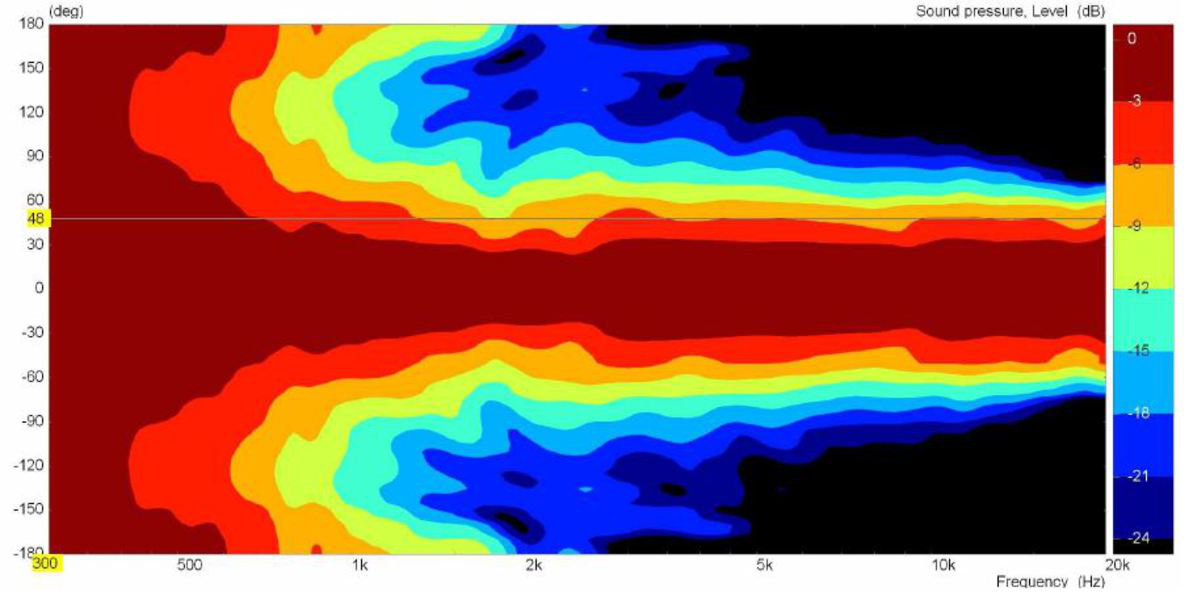
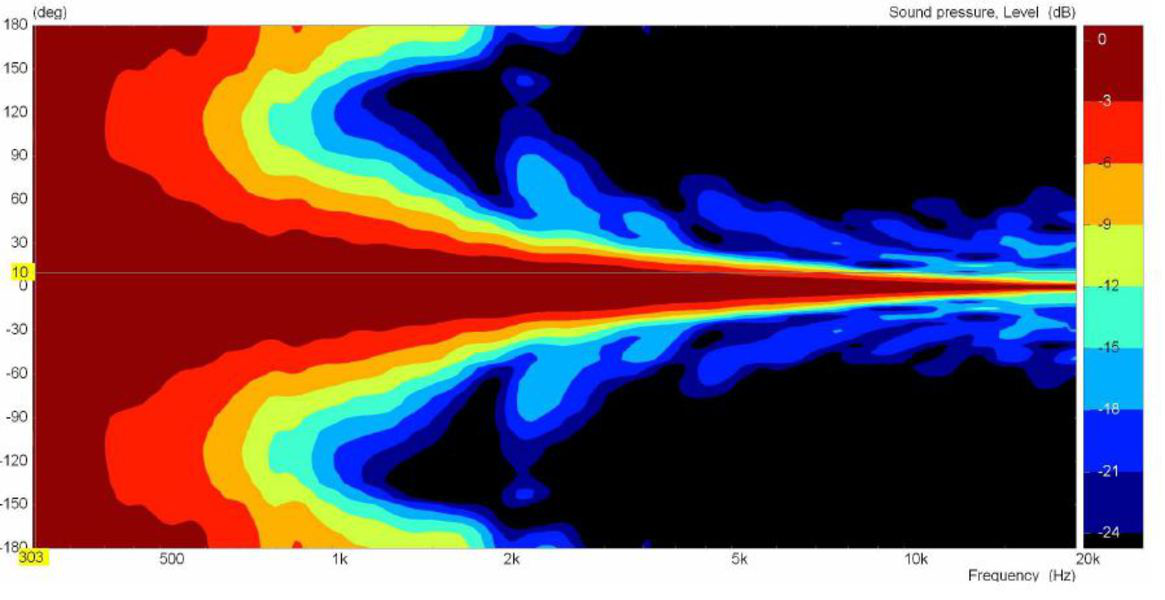
The constant-directivity design maintains the 90° × 20° coverage pattern from 600 Hz through 18 kHz. That’s the widest constant-directivity bandwidth of any horn 18Sound offers — wider than the XR series’ 1.2–16 kHz range by nearly a full octave at both the low and high ends. For system designers, this means the horn controls directivity across almost the entire vocal and presence frequency range, producing consistent tonal balance from on-axis to the edge of the coverage pattern.
The AMT200P pairing is not optional — the 18 Sound XMT200 is engineered specifically for this transducer. The 167 mm throat diameter, the internal flare geometry, and the horn’s acoustic loading characteristics are all calculated around the AMT200P’s unique radiation pattern and impedance requirements.
Design and Construction of the 18 Sound XMT200
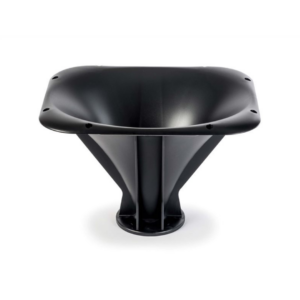
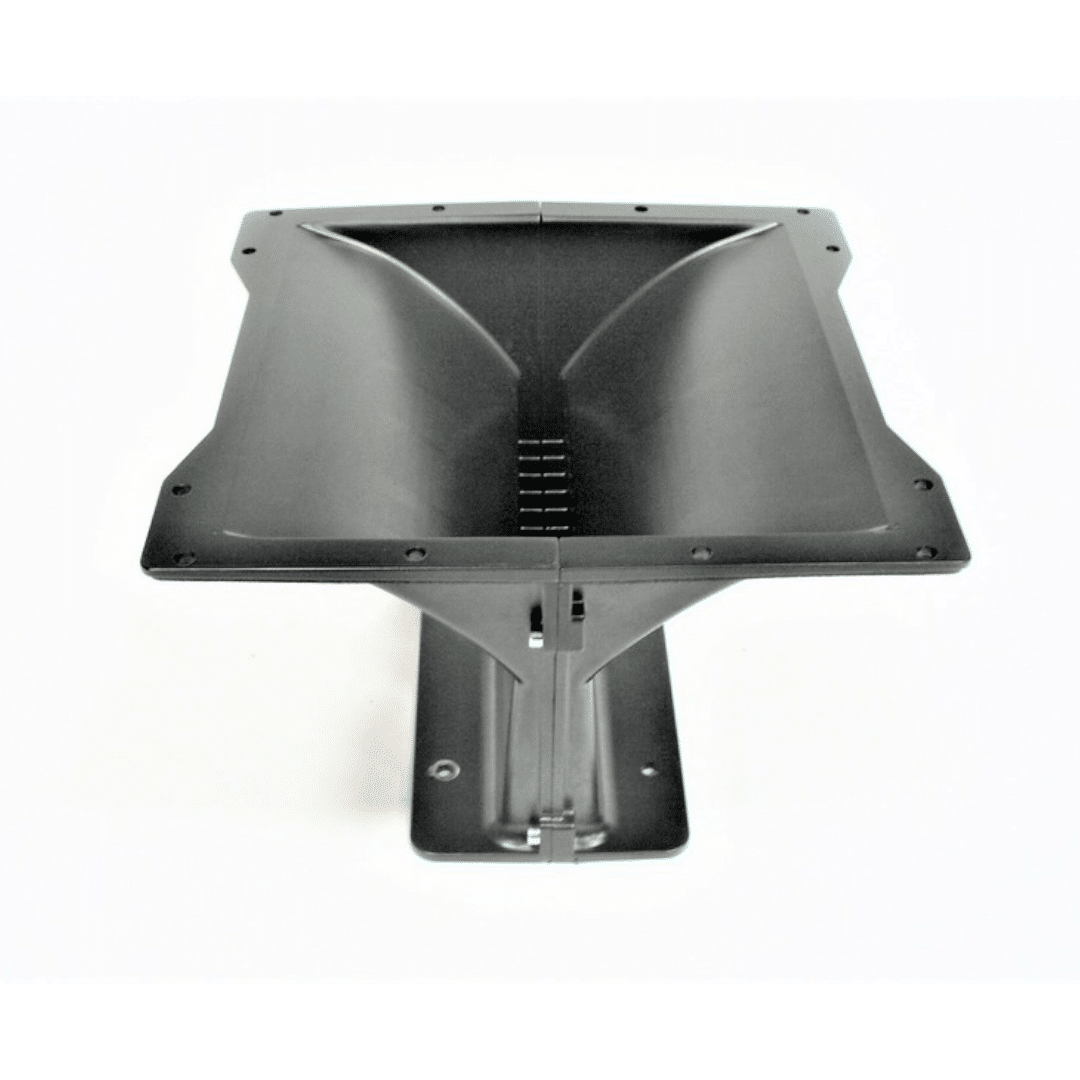
The 18 Sound XMT200 uses a constant-directivity flare profile with a 167 mm (6.57-inch) throat entry expanding to a 236 × 230 mm mouth. The 167 mm throat is the largest of any horn in 18Sound’s range — nearly five times the XG14’s 35 mm throat and seven times the XG10’s 25 mm throat. This enormous throat diameter is required because the AMT200P Air Motion Transformer has a much larger radiating surface than a conventional compression driver exit.
An Air Motion Transformer works on a completely different principle from a compression driver. Where a compression driver uses a dome diaphragm to push air through a phase plug and throat, an AMT uses a pleated, folded diaphragm — imagine an accordion-folded membrane with conductive traces bonded to its surface. When current flows through the traces in a magnetic field, the folds squeeze together and apart, pushing air out of the pleats at a velocity roughly five times faster than the diaphragm itself moves. The result is extremely fast transient response and very low distortion, because the air movement is amplified mechanically by the folding geometry rather than relying on a single surface pushing forward.
The AMT’s large pleated diaphragm produces a radiating area that needs a correspondingly large throat to couple to. The 18 Sound XMT200’s 167 mm throat provides that coupling — matching the AMT200P’s output to the horn’s expanding flare without the compression losses that would occur if the throat were too small.
The constant-directivity flare counteracts the natural tendency of horns to narrow their coverage as frequency increases. At 600 Hz, the 236 × 230 mm mouth is large enough relative to the wavelength to establish directivity. At 18 kHz, the flare geometry prevents the coverage from collapsing into a narrow on-axis beam. Between these extremes, the 18 Sound XMT200 maintains 90° × 20° coverage that is consistent enough for professional system design to rely on.
The 90° horizontal coverage is the standard angle for medium-throw PA applications. The 20° vertical is wider than the XG10/XG14’s 10° — this is not a line array waveguide. It’s a standalone horn for two-way and multi-way speaker systems where the HF section needs to cover a 20-degree vertical window. In a line array context, the 20° vertical still allows stacking — 18Sound’s own suggested designs show the XMT200 in a two-way line array with dual 8NTLW2000 woofers — but with wider per-element vertical coverage than the XG series provides.
18Sound specifically engineered the 18 Sound XMT200 to eliminate the midrange narrowing and high-frequency beaming problems common in many similar horns. The flare profile transitions smoothly through the mid-range without the coverage collapse that poorly designed horns exhibit in the 2–4 kHz band. The high-frequency extension to 18 kHz confirms the horn maintains useful pattern control through the uppermost treble.
The diecast aluminium construction provides stiffness, dimensional stability, and thermal management. Aluminium is stiffer than plastic or composite alternatives — critical for a horn this size where the acoustic pressures at the throat are substantial. The aluminium structure also conducts heat away from the AMT200P, which is important because the transducer generates heat during sustained high-power operation.
18Sound highlights optimised heat dissipation as a specific design feature. The aluminium horn body acts as a heatsink for the AMT200P, drawing thermal energy from the transducer and radiating it from the horn’s external surface area. For sustained high-SPL operation, this passive thermal management extends the AMT’s usable operating time before thermal compression affects output.
At 1.3 kg, 236 × 230 × 153 mm, the 18 Sound XMT200 is compact relative to its 167 mm throat and 600 Hz cutoff. The 200 × 210 mm rectangular baffle cutout provides a clean mounting interface for cabinet integration.
Performance and Applications for the 18 Sound XMT200
The 18 Sound XMT200 provides 90° × 20° constant-directivity coverage from 600 Hz to 18 kHz when loaded with the AMT200P Air Motion Transformer. The constant directivity across nearly five octaves means the audience hears consistent tonal balance across the entire 90° × 20° coverage window — not just on-axis. Off-axis listeners experience similar frequency response to on-axis listeners, which is the defining characteristic of a well-designed constant-directivity horn.
The 600 Hz cutoff frequency means the horn provides useful acoustic loading and directivity control from the lower mid-range. In a two-way system, crossing over at 600 Hz — or anywhere above it — puts the horn in control of directivity from the lower mid-range through the entire treble range. The woofer handles content below 600 Hz where its own directivity is naturally wide, and the horn takes over everything above. The directivity transition at 600 Hz is smoother and more natural than crossover points at 1–2 kHz because the wavelengths at 600 Hz are long enough for the woofer and horn to overlap with gradual, phase-coherent filter slopes.
The very low distortion at high sound pressure that 18Sound highlights is a combined benefit of the horn design and the AMT technology. The horn’s smooth flare profile minimises horn-induced distortion from internal reflections. The AMT200P’s pleated diaphragm minimises transducer-induced distortion through its mechanical advantage — the fold geometry amplifies air velocity without requiring high diaphragm acceleration. Together, the 18 Sound XMT200 and AMT200P produce cleaner output at high SPL than most compression-driver-on-horn combinations.
18Sound’s suggested enclosure designs show the 18 Sound XMT200 in a two-way line array configuration with dual 8NTLW2000 Dual Gap woofers and one AMT200P. This configuration places the 18 Sound XMT200 in the role typically filled by a compression driver on a line array waveguide — but with the AMT’s superior transient response and the horn’s 600 Hz constant directivity providing better coverage control and lower distortion than conventional line array HF sections.
The 20° vertical coverage makes the 18 Sound XMT200 suitable for both standalone speaker systems and loosely coupled arrays. Where the XG10 and XG14 provide 10° vertical for tight element spacing in conventional line arrays, the 18 Sound XMT200’s 20° covers a wider vertical window per element. Fewer elements are needed to cover the same vertical angle, which simplifies array design and reduces element count.
The AMT-only compatibility is both a feature and a constraint. The 18 Sound XMT200 works exclusively with the AMT200P — no other transducer fits the 167 mm throat or matches the acoustic loading the horn is designed to provide. Builders specifying the 18 Sound XMT200 are committing to the AMT platform. For those who do, the reward is a horn-and-transducer combination that delivers wider constant-directivity bandwidth, lower distortion, and faster transient response than any compression driver pairing in 18Sound’s range.
Conclusion – 18 Sound XMT200 Horn
The 18 Sound XMT200 is the only horn in 18Sound’s range designed for an Air Motion Transformer — and the 600 Hz cutoff, 90° × 20° constant directivity from 600 Hz to 18 kHz, and 167 mm throat make it unlike anything else in the catalogue. It provides nearly five octaves of consistent pattern control, the lowest cutoff frequency of any 18Sound horn, and the acoustic loading that the AMT200P needs to deliver its full performance.
The AMT200P pairing is what makes this horn worth specifying. The Air Motion Transformer’s folded diaphragm produces faster transient response and lower distortion than compression driver technology — and the 18 Sound XMT200 was engineered from scratch to extract that performance. The constant-directivity flare, the thermal management from the aluminium body, and the 167 mm throat coupling are all optimised for one transducer.
For builders ready to move beyond compression drivers to AMT technology, the 18 Sound XMT200 is the horn that makes the transition practical. It’s purpose-built, it works with one transducer, and it delivers constant-directivity coverage from 600 Hz that no compression driver horn in 18Sound’s range can match.

VIEW MORE 18 Sound PRODUCTS HERE.
About 18 Sound

18 Sound products are proudly made in Reggio Emilia, Italy, combining advanced technology with Italian craftsmanship. Known for their high-performance professional audio components, 18 Sound is a trusted name in the global audio industry. Their state-of-the-art manufacturing and strict quality control ensure exceptional reliability and sound clarity. 18 Sound products are designed to meet the demands of speaker builders and audio professionals, 18 Sound offers premium products with outstanding value and performance worldwide.