18 Sound XT1464 – Large-Format Elliptical 1.4-Inch Horn with 500 Hz Cutoff and Spherical Wave-Front
The 18 Sound XT1464 is the largest and deepest-reaching 1.4-inch horn in 18 Sound’s range. With a 0.5 kHz cutoff frequency — 300 Hz lower than the XR1464C and 400 Hz lower than the PR614 — a 60° × 50° constant-coverage pattern, ESS (Elliptical Shape) technology, and a 380 × 304 mm mouth that provides the radiating area needed for pattern control at 500 Hz, the 18 Sound XT1464 operates in a frequency range where smaller 1.4-inch horns have no useful directivity at all.
The 500 Hz cutoff is the headline specification. It’s the lowest cutoff of any standard 1.4-inch horn in 18 Sound’s range — lower than the XR series’ 800 Hz, lower than the PR614’s 900 Hz, and lower than any conventional compression driver horn we’ve covered from any manufacturer except the specialised AMT-only XMT200. At 500 Hz, the 18 Sound XT1464 loads the compression driver and controls directivity in the lower mid-range — a frequency band where smaller-mouth horns are physically incapable of establishing pattern control.
The 380 × 304 mm mouth is the reason the 18 Sound XT1464 achieves what smaller horns can’t. Horn cutoff frequency is determined by mouth area relative to wavelength. A 500 Hz wave is approximately 690 mm long — establishing directivity at this frequency requires a mouth large enough to be a meaningful fraction of that wavelength. The 380 mm horizontal dimension and 304 mm vertical dimension provide the radiating area that makes 500 Hz pattern control physically possible.
18 Sound developed the horn contours using Computer Aided Finite Element Analysis. The horn structure is made from high-pressure die-cast polyurethane foam — a material that eliminates resonance and vibrations while maintaining maximum strength at minimum weight. Despite the 380 × 304 × 257 mm dimensions, the 18 Sound XT1464 weighs just 1.4 kg — the same weight as the much smaller XR1464C.
The 18 Sound XT1464 provides a spherical wave-front, avoiding the reflections and other disadvantages usually associated with diffraction horns. It has been designed to exactly match 18 Sound’s 1.4-inch exit neodymium high-frequency compression drivers.
Design and Construction of the 18 Sound XT1464
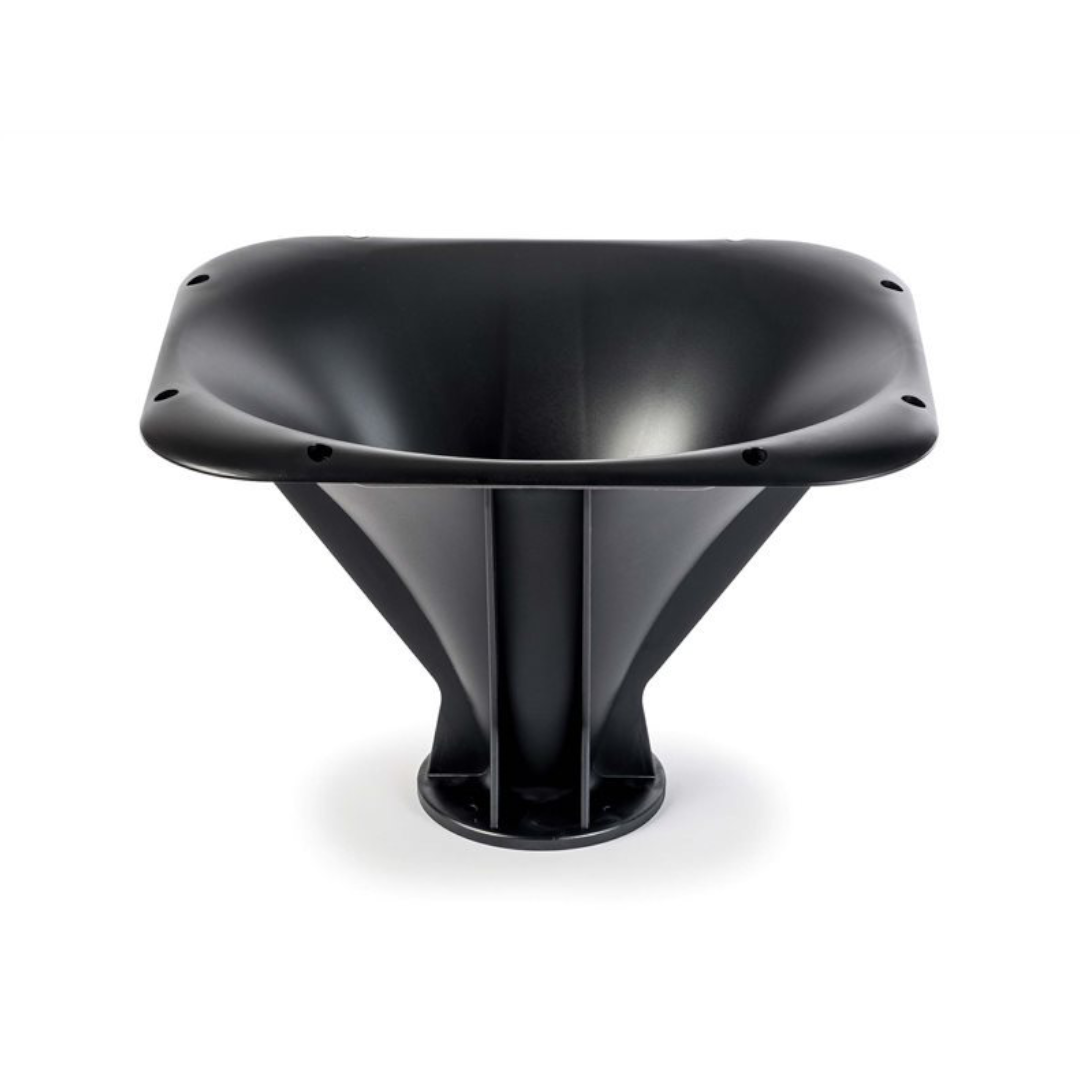
The 18 Sound XT1464 uses an ESS (Elliptical Shape) flare profile with a 35 mm (1.4-inch) throat entry expanding to a 380 × 304 mm elliptical mouth. The ESS geometry uses an asymmetric mouth — wider horizontally (380 mm) for 60° coverage, narrower vertically (304 mm) for 50° coverage — matching the mouth dimensions to the different coverage requirements in each plane.
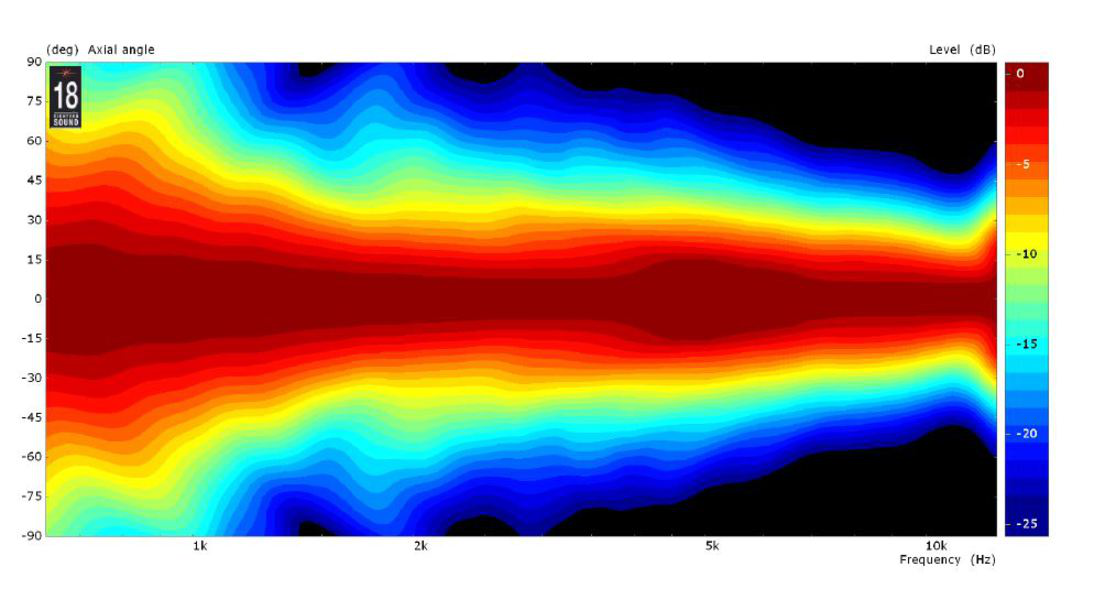
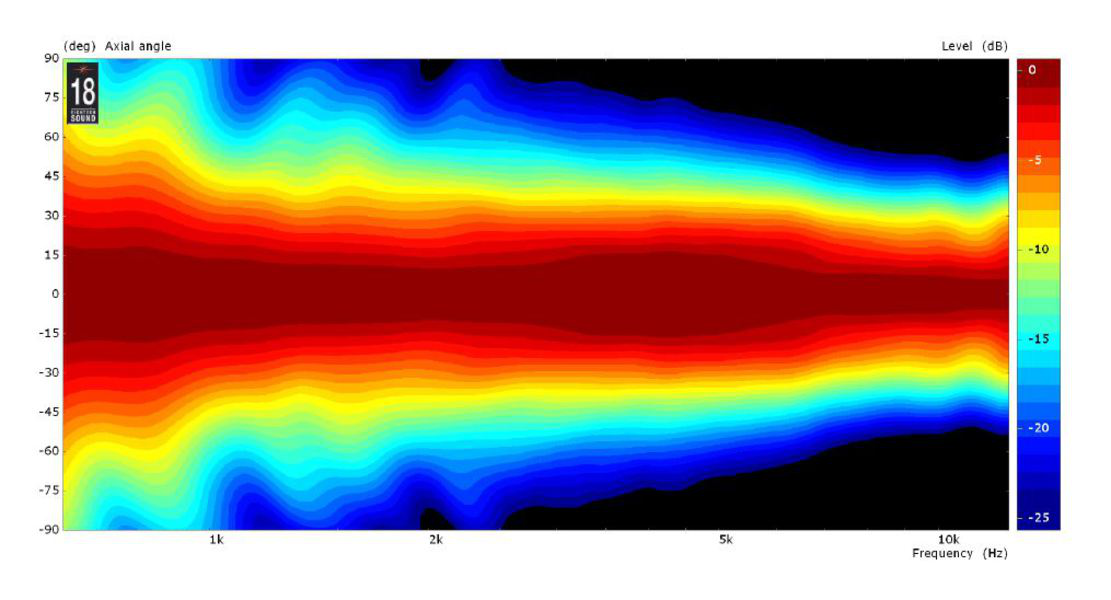
The 380 mm horizontal mouth provides pattern control at frequencies that the XR1464C’s 270 mm and the PR614’s 330 mm can’t reach. At 800 Hz, the 18 Sound XT1464’s horizontal dimension is large enough to establish directivity — and 18 Sound confirms consistent horizontal frequency response from 800 Hz to 15 kHz. The 304 mm vertical dimension establishes directivity from 1.5 kHz — higher than horizontal because the narrower vertical mouth is a smaller fraction of the wavelength at lower frequencies.
The constant coverage begins at 1.5 kHz where both planes are controlled simultaneously. Below 1.5 kHz, horizontal coverage is controlled but vertical coverage widens. Below 800 Hz, both planes are uncontrolled. Above 15 kHz, the coverage begins to narrow as wavelengths become too short for the mouth geometry to prevent beaming.
The 60° × 50° coverage angles are different from the XR1464C’s 60° × 40° and the PR614’s 60° × 40°. The wider 50° vertical is a meaningful difference — 10° more vertical coverage means a taller listening window and more forgiveness in speaker placement height. In venues with a balcony or raised seating, the extra 10° of vertical can be the difference between covering the upper level and missing it.
The compact vertical mouth dimension (304 mm) is designed for vertical stacking. 18 Sound notes that the 18 Sound XT1464 can be stacked vertically when lower frequency control is required. Multiple horns stacked create a taller effective vertical aperture, which provides directivity at lower frequencies than a single horn can achieve — a technique used in high-output touring systems where mid-frequency pattern control is critical.
The injection-moulded polyurethane foam construction is the material that makes the 18 Sound XT1464’s weight-to-size ratio possible. Polyurethane foam is exceptionally lightweight — it’s a cellular structure with high stiffness-to-weight ratio that provides the acoustic damping needed to eliminate horn resonance without the mass of solid aluminium or composite.
At 1.4 kg for a 380 × 304 × 257 mm horn, the 18 Sound XT1464 weighs the same as the XR1464C’s much smaller 270 × 270 × 180 mm body. The polyurethane foam is roughly half the density of composite and a fraction of aluminium’s density — which is how a horn nearly twice the volume of the XR1464C weighs the same.
The trade-off is thermal management. Polyurethane foam is a thermal insulator, not a conductor. Unlike the PR614’s diecast aluminium, which draws heat from the compression driver and reduces its operating temperature by up to 30°C, the 18 Sound XT1464’s foam body does not provide thermal management. The compression driver runs at its own temperature. For sustained high-power applications, this means more power compression from the driver compared to an aluminium horn of the same cutoff frequency.
The spherical wave-front is the acoustic consequence of the ESS flare geometry. The horn produces a wavefront that expands spherically from a virtual point source at the horn’s acoustic centre. This spherical expansion means the sound field behaves predictably at distance — the inverse square law applies uniformly, and the coverage pattern translates consistently from near-field to far-field without the asymmetric decay patterns that planar or cylindrical wavefronts can produce.
The 257 mm depth is significantly deeper than the XR1464C’s 180 mm and the PR614’s depth. The larger mouth and lower cutoff require a longer flare path from throat to mouth, which adds depth behind the baffle. Cabinet designers need to account for over 10 inches of horn depth when integrating the 18 Sound XT1464.
Performance and Applications for the 18 Sound XT1464
The 18 Sound XT1464 provides 60° × 50° constant coverage with consistent on-axis and off-axis frequency response from 800 Hz to 15 kHz horizontally and 1.5 kHz to 15 kHz vertically. The constant directivity engages at 1.5 kHz where both planes achieve controlled coverage simultaneously.
The 0.5 kHz cutoff means the horn provides useful acoustic loading from 500 Hz — the lowest of any standard 1.4-inch horn in 18 Sound’s range. For compression drivers with 1–1.5 kHz recommended crossover frequencies, the 18 Sound XT1464 is loaded across the entire crossover region and well below it. There’s no gap between where the woofer loses control and where the horn establishes it — the overlap zone is wide and well-supported.
The 800 Hz horizontal consistency means the horn shapes the compression driver’s output from the upper bass upward. In a two-way system crossing over at 1 kHz, the 18 Sound XT1464 controls horizontal directivity from 200 Hz below the crossover point. This produces the smoothest possible directivity transition from woofer to horn — the horn is already fully controlling horizontal coverage before the crossover even begins.
The 15 kHz upper limit of consistent response is lower than the XR1464C’s 16 kHz and the PR614’s 18 kHz. The larger mouth and deeper flare geometry of the 18 Sound XT1464 trade some high-frequency consistency for the dramatically lower cutoff frequency and larger coverage window. For most professional applications, 15 kHz covers the vast majority of musically significant high-frequency content.
The comparison to the XR1464C and PR614 illustrates three different design philosophies for the same 60° horizontal coverage from a 1.4-inch throat:
The XR1464C delivers the lowest weight (1.4 kg tied with XT1464), the most compact size (270 × 270 × 180 mm), constant directivity to 16 kHz, and 0.8 kHz cutoff. It’s the compact, lightweight option.
The PR614 delivers aluminium thermal management, the highest upper CD range (18 kHz), an elliptical shape optimised for 12-inch woofer baffles, and 0.9 kHz cutoff. It’s the thermally managed, highest-bandwidth option.
The 18 Sound XT1464 delivers the lowest cutoff (0.5 kHz), the widest vertical coverage (50° vs 40°), the largest mouth for the most low-frequency control, and a spherical wave-front. It’s the maximum-reach, maximum-loading option for systems where horn coverage at 500–800 Hz matters more than minimum size or thermal management.
The 18 Sound XT1464 pairs with any 18 Sound 1.4-inch exit compression driver. The 35 mm throat is standard. B&C 1.4-inch drivers also fit — the throat is universal across manufacturers.
Conclusion – 18 Sound XT1464 Horn
The 18 Sound XT1464 is the deepest-reaching 1.4-inch horn in 18 Sound’s range. The 0.5 kHz cutoff loads the compression driver from 500 Hz — 300 Hz lower than the XR1464C, 400 Hz lower than the PR614 — providing horn loading and directivity control in the lower mid-range where smaller horns have no useful pattern control at all.
The 380 × 304 mm ESS elliptical mouth is the engineering that makes it possible. More mouth area means lower cutoff. More mouth area means more directivity at lower frequencies. The polyurethane foam construction keeps the weight to 1.4 kg despite the dramatically larger dimensions — the same weight as the XR1464C in a body nearly twice the volume.
The trade-offs are real: 257 mm depth requires deep cabinets, no thermal management from the foam body, and the 15 kHz upper consistency is lower than the XR and PR alternatives. For systems where the horn’s low-frequency reach and 500 Hz loading are the priorities — and the cabinet can accommodate the depth — the 18 Sound XT1464 delivers pattern control at frequencies that no other standard 1.4-inch horn in 18 Sound’s range can reach.
Largest mouth, lowest cutoff, widest vertical coverage, spherical wave-front, 1.4 kg. The 18 Sound XT1464 is the 1.4-inch horn for builders who need the horn to start working at 500 Hz.
VIEW MORE 18 Sound PRODUCTS HERE.
About 18 Sound

18 Sound products are proudly made in Reggio Emilia, Italy, combining advanced technology with Italian craftsmanship. Known for their high-performance professional audio components, 18 Sound is a trusted name in the global audio industry. Their state-of-the-art manufacturing and strict quality control ensure exceptional reliability and sound clarity. 18 Sound products are designed to meet the demands of speaker builders and audio professionals, 18 Sound offers premium products with outstanding value and performance worldwide.